Kimi K3 vs Claude Fable 5 vs GPT-5.6 Sol: Leaderboards and Real Experience?
Before we begin: I am writing this based on my own requirements. If your workflow is different, make sure to select a model that suits your work.
I have always treated leaderboards as a rough sketch, not a final verdict. The real test begins the moment you put a model to work on actual projects, especially from the command line (CLI). Over the past few weeks, I put Claude Fable 5, GPT-5.6 Sol, and the newly released Kimi K3 through demanding workloads. The official hype around Fable 5 and Sol is loud, but my day-to-day experience tells a much more practical story.
The Numbers (Independent Reality Check)
Independent evaluations (not the companies’ own marketing sheets) currently look like this:
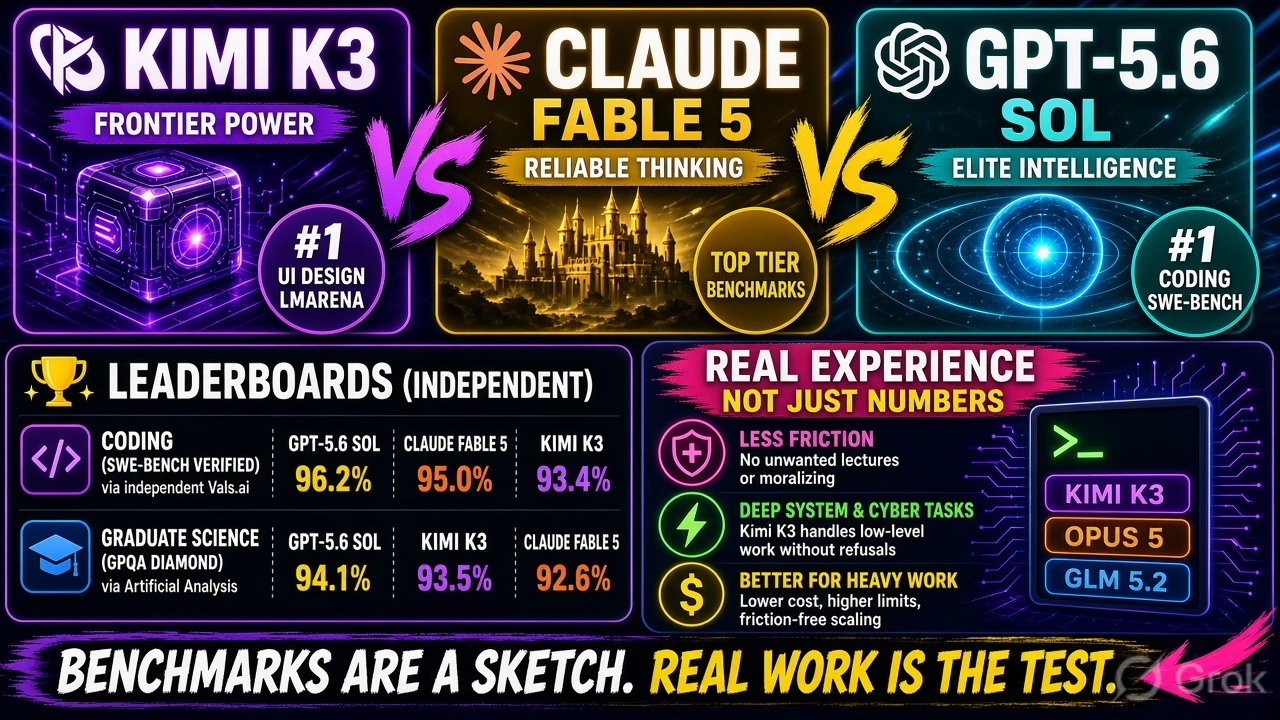
- Coding (SWE-bench Verified via independent Vals.ai harness): GPT-5.6 Sol — 96.2%, Claude Fable 5 — 95.0%, Kimi K3 — 93.4%.
- Graduate-Level Science (GPQA Diamond via Artificial Analysis): GPT-5.6 Sol — 94.1%, Kimi K3 — 93.5%, Claude Fable 5 — 92.6%.
On pure independent benchmarks, the top models are very close. However, when it comes to Frontend and UI Design on LMArena (blind human votes), Kimi K3 actually takes the 1st spot, beating the others. In the overall Artificial Analysis Intelligence Index, Kimi K3 sits right behind Fable 5 and Sol, proving it easily belongs in the top tier. But in real-world use, the operational differences feel much larger.
Hallucinations and How I Actually Work
Artificial Analysis flags Kimi K3 with a higher hallucination rate, but for my workflow, that isn't a problem:
- Pre-plan review: Before starting, I first explain the task to the AI and review its intended approach. Because I catch and fix errors right then and there, hallucinations rarely cause big issues.
- No unwanted lectures: What I value most is a model that stays quiet, follows instructions, and gets the job done without moral commentary or unsolicited advice.
- Workflow fit: If someone doesn't verify their code at all, relying on the top two models makes more sense.
Deep System Work and Cyber-Security Tasks
Putting these models through low-level system tasks reveals stark operational differences:
- NeuroTrap and Kernel Work: Kimi K3 was the first model I ran extensively through the OpenCode CLI agent for my NeuroTrap project. It handled low-level Linux kernel modifications and system components smoothly.
- Cyber-security friction: Other flagship models carry heavy safety filters. Straightforward technical requests are frequently met with refusals or long explanations of why the model will not help.
- Uninterrupted workflow: Kimi K3 stays focused purely on the technical goal without constant push-back. For anyone regularly working on cyber-security or system tasks, this lack of friction is decisive.
Pro Plans, Limits, and Daily Reality
Benchmark scores look impressive on paper, but practical execution tells another story.
Even when using Pro Plans—running GPT-5.6 Sol via Codex and Fable 5 via Claude Code—the weekly limits hit way too fast. Heavy token consumption leaves you waiting for limits to reset. Combined with high subscription costs and aggressive safety filtering, relying on these flagship models for heavy bulk work becomes deeply frustrating.
Final Setup and Model Rotation
Real projects, real terminals, and budget constraints determine which model stays open all day.
With Kimi K3 releasing open weights on 27 July, cheap third-party API access will make high-volume, friction-free work even easier. Meanwhile, I am integrating Claude Opus 5 into the NeuroTrap workflow to see if its performance outweighs its refusal rate, while keeping GLM 5.2 as a solid zero-cost tertiary option across free providers.
Right now, Kimi K3 remains my primary daily driver for heavy bulk tasks, with Opus 5 as my secondary test option and GLM 5.2 as a reliable backup.