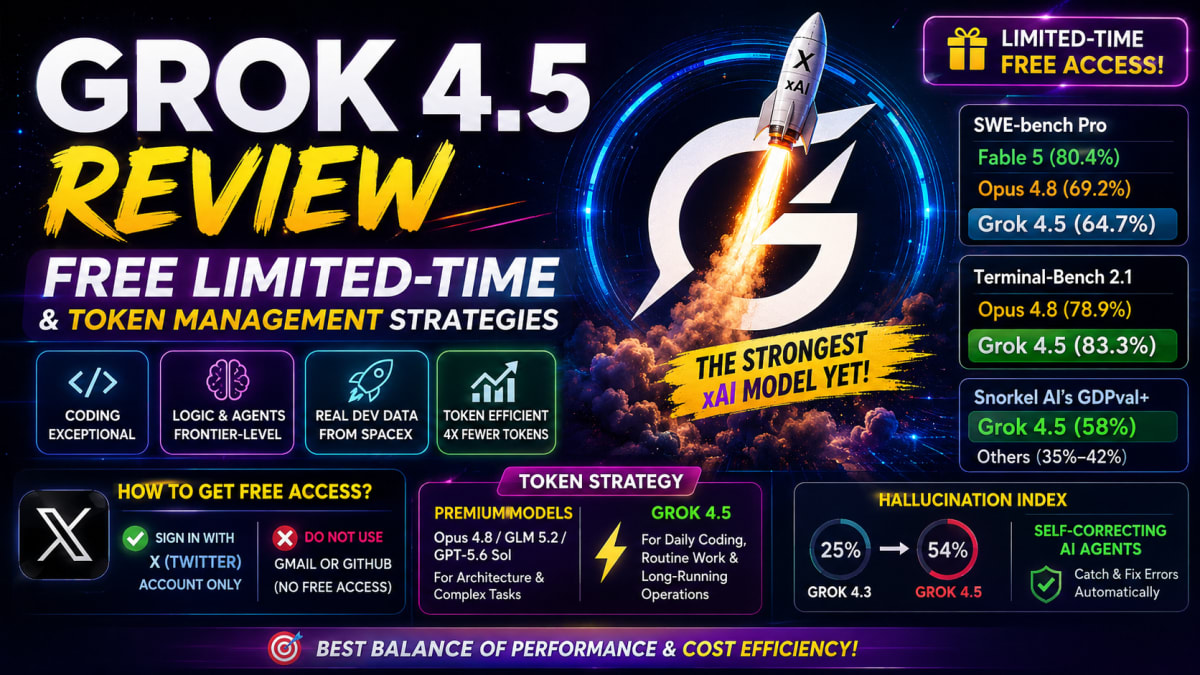
I recently tested Grok 4.5 using the Grok CLI tool, which currently offers a limited-time free trial. For setup, refer to the official documentation or YouTube tutorials. Key tip: When signing in, use an X (Twitter) account only — do not log in with Gmail or GitHub, as the free offer activates exclusively with an X account.
I put Grok 4.5 through its paces on my personal project NeuroTrap and several everyday tasks. It performed exceptionally well and stands out as the strongest xAI model yet, especially in coding capabilities. It genuinely surprised me.
Benchmark Scores & Performance
- Opus 4.8 scores 69.2% on the SWE-bench Pro leaderboard, while Fable 5 leads at 80.4%. Grok 4.5 follows closely with a solid 64.7%.
- In Terminal-Bench 2.1, Grok 4.5 achieves 83.3% success rate, outperforming Opus 4.8’s 78.9%.
- The big leap in coding skills comes from SpaceX acquiring Cursor for $60B and feeding real developer session data into Grok 4.5’s training.
- On education tasks (Snorkel AI’s GDPval+), Grok 4.5 delivers a 58% pass rate, beating other frontier models (35–42%).
Real-World Experience
In my testing with NeuroTrap and other projects, Grok 4.5 delivered mixed but practical results.
- Front-end and UI tasks are average but functional. It understands concepts well and builds working HTML/CSS/JS layouts or basic 3D setups, though animations can feel janky and often need manual polishing.
- Back-end, logic, and agentic tasks are exceptional and frontier-level. It excels in complex operations, mathematical reasoning, data pipelines, model fine-tuning, and autonomous agent workflows with strong context handling and minimal handholding.
This balance makes Grok 4.5 particularly strong for projects that rely heavily on backend and agentic work like NeuroTrap.
Token Economics & Smart Usage Strategy
Token efficiency matters most for developers as it directly impacts costs. Using premium flagship models for every routine task wastes money.
Grok 4.5 excels here — in testing it used roughly four times fewer output tokens than Opus 4.8.
- My recommendation is to use one premium flagship model (Opus 4.8, GLM 5.2, or GPT-5.6 Sol) for critical architecture and complex tasks.
- Reserve Grok 4.5 for daily coding, routine work, and long-running operations.
This multi-model approach delivers the best balance of performance and budget efficiency.
Hallucination & Reliability
Grok 4.5 still hallucinates at times (54% on the Artificial Analysis Omniscience Index, up from 25% in Grok 4.3). It can miss minor details in long prompts.
However, modern autonomous AI agents handle this well through self-correction loops that automatically catch and fix runtime errors. This makes Grok 4.5 highly practical for complex projects.
Final Takeaway
Choose a premium model for heavy architectural work, but offload daily execution, terminal operations, and sustained agent loops to Grok 4.5. You’ll save significantly while maintaining strong productivity.