Gemini 3.5 Flash vs. 3.1 Pro: Ground Reality vs. Benchmark Hype
It’s been quite a long time since I seriously used any "Flash" model for my work. Honestly, I had completely stopped using them, along with those smaller open-source models, because their performance was just not up to the mark. But recently, Gemini 3.5 Flash caught my attention. It is definitely a good release from Google, but to be very frank, the actual ground reality doesn't match the massive hype they have created.
My all-time favorite was Google's Gemini 3.0 Pro. After that, Gemini 3.1 Pro didn't really impress me that much. So, I started testing 3.5 Flash with some doubts. Here is what the leaderboards claim and what actually happens when you give it real-world tasks.
The Benchmark Illusion vs. Real Execution
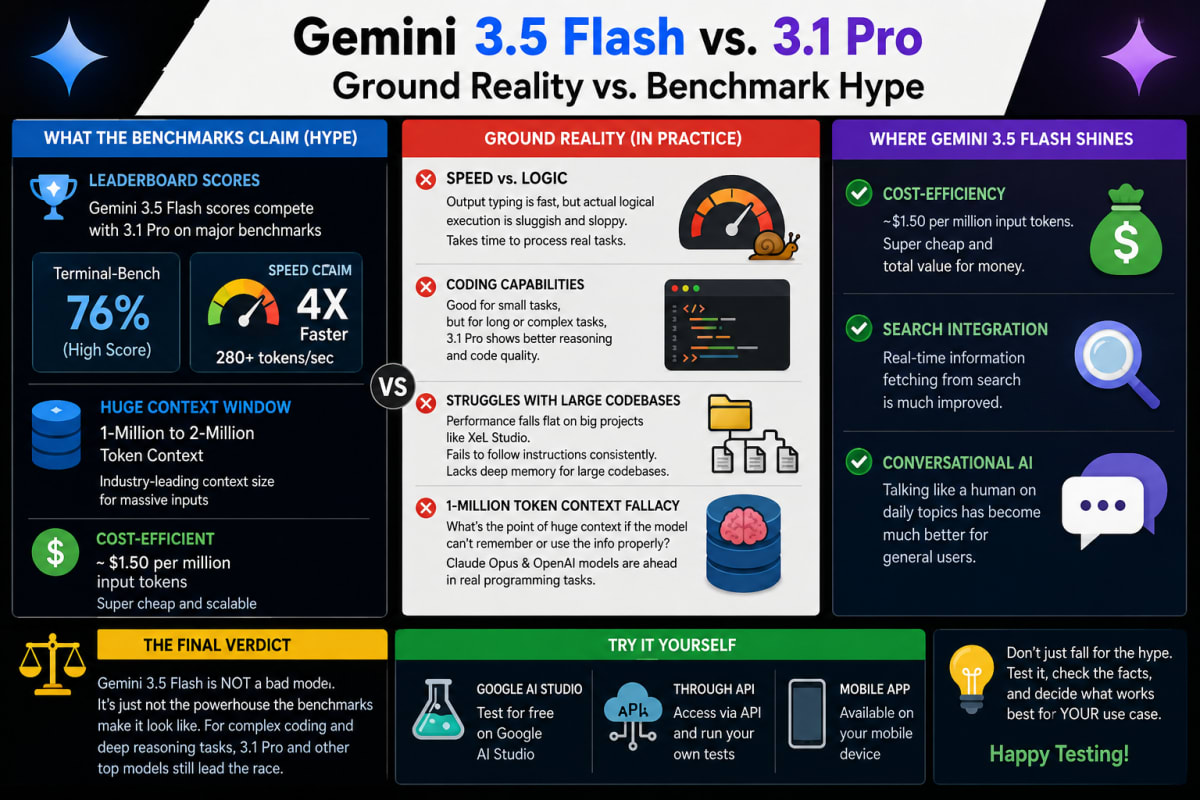
If you look at the leaderboards, Gemini 3.5 Flash looks like a massive jump. On paper, it shows scores that easily compete with Gemini 3.1 Pro, heavily showing off that 76% score on Terminal-Bench and claiming speeds up to 4x faster (giving around 280+ tokens per second).
But here is the catch:
- Speed vs. Logic: They highlight blistering speed, but in my own projects, this speed is actually deceiving. Generating words fast doesn't mean it is doing the _work_ fast. When I asked it to start a new sequence in my workspace, it took so much time to process. The output typing is fast, but the actual logical execution is very sluggish and sloppy.
- Coding Capabilities: It handles small programming tasks decently. But for long or complex tasks, the pure reasoning is still better in the older 3.1 Pro, and you can easily feel it while working.
The Big Struggle with Large Codebases
The main reality check happened when I used 3.5 Flash for some minor changes in XeL Studio. Because the codebase of XeL Studio is large, the model's performance completely fell flat.
Unlike bigger models that remember coding rules, 3.5 Flash was struggling to follow ongoing instructions. It just doesn't have that deep memory required to handle large codebases properly.
The 1-Million Token Context Fallacy
Google keeps shouting about their 1-million to 2-million token context window. But seriously, what is the point of giving so much context if the model can't even remember or use the information inside it properly?
Even with this huge context, Anthropic's Claude Opus series and the latest OpenAI models are still way ahead in programming. Their context window might look smaller on paper, but their ability to catch small details, fix complex bugs, and strictly follow developer instructions easily beats Google’s current coding models.
Where Gemini 3.5 Flash Actually Shines
But I have to give credit where it's due. It is not totally useless. There are a few things where Google has actually done a great job:
- Cost-Efficiency: At just around $1.50 per million input tokens, it is super cheap and total value for money for lighter tasks.
- Search Integration: Fetching real-time info from search is very much improved.
- Conversational AI: For general users, talking to it like a normal human on daily topics has become much better now.
The Final Verdict
At the end of the day, everybody's use case is different. What fails in my complex coding work might be perfect for your daily tasks. Earlier, my personal testing used to match the leaderboards, but this time, the difference is just too big to ignore.
But hey, don't just take my word for it. Gemini 3.5 Flash is easily available right now. You can test it for free on Google AI Studio, through the API, or directly on your mobile app. Just do your own testing, check the facts, and get a clear idea yourself before falling for the hype.