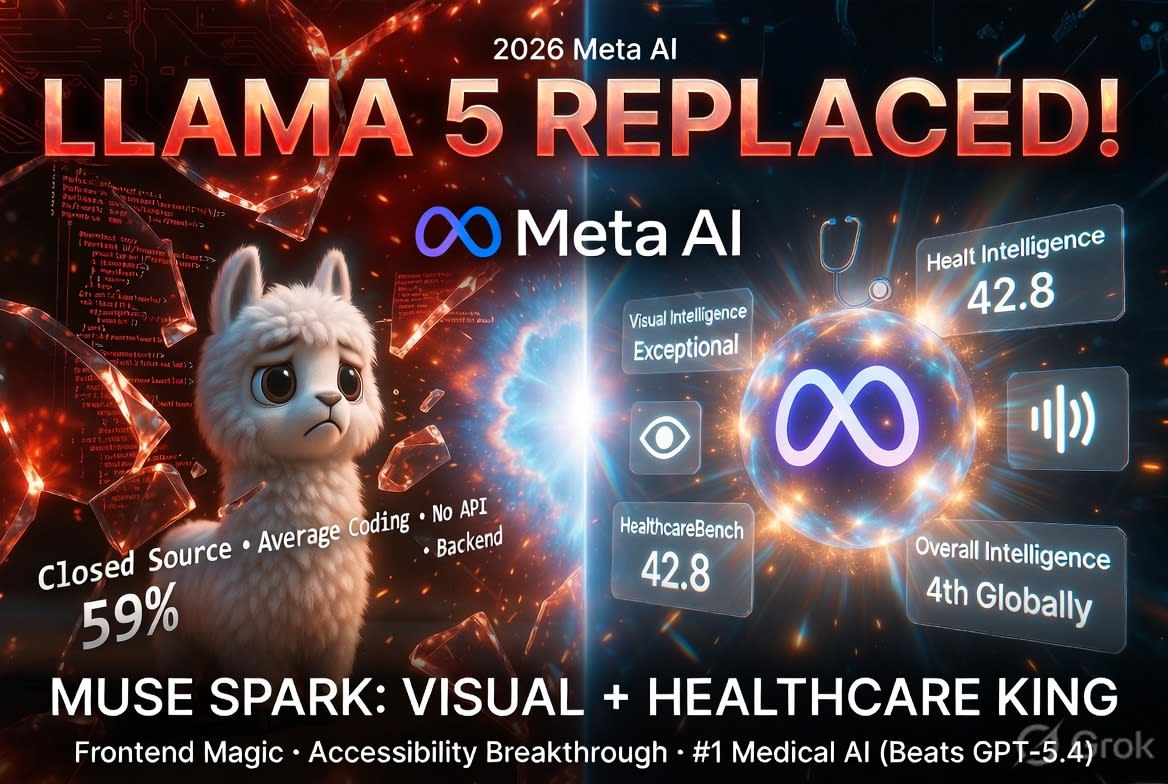
In April 2026, Meta introduced Muse Spark, stepping away from the open-source LLaMA series. I have deeply analyzed this model, testing it firsthand where possible. Here is a straightforward breakdown of what it actually offers.
A Major Shift: Closed Source and No API Unlike LLaMA, Muse Spark is not open-source. Personally, I am quite disappointed that it is now proprietary. Since its release, Meta has not provided a public API key yet. Because of this, I had to test the model directly through Meta's official platform, which limits deep experimentation.
My Personal Test: Backend Logic and Coding Honestly, the backend performance felt strictly average to me. The benchmark data from Artificial Analysis backs up my experience:
- It scored 77.4% in coding, putting it behind top competitors.
- For complex, multi-step automation on Terminal-Bench 2.0, it struggles and drops to a 59% score.
- If you need heavy-duty programming, models like Claude Opus 4.6, GPT-5.4, or Gemini 3.1 Pro are still much better choices.
Where It Truly Stands Out: Visual Intelligence While the backend felt average, its frontend logic and visual reasoning are incredible. I have given it many images and UI screenshots to write code, and it performed exceptionally well. It can:
- Analyze the layout and structure instantly.
- Generate the matching frontend code.
- Automatically extract images and icons from the screenshot directly into the code, saving a lot of manual work.
A Breakthrough for Accessibility Because it processes images, text, and audio together, it is a massive step forward for visually impaired users. When combined with Meta's smart devices, it can:
- Identify real-world objects and describe surroundings in real-time.
- Read labels, packaging, and complex charts aloud.
- Assist with daily navigation, offering a meaningful level of independence.
Strongest Area: Healthcare Intelligence (Data via Artificial Analysis) While I didn't test this medically myself, data from Artificial Analysis shows Muse Spark performs exceptionally well in medical reasoning. Trained with data from over 1,000 doctors, it leads the market in health-related benchmarks.
- On the HealthBench test, it scored 42.8.
- It easily outperformed GPT-5.4 (40.1) and Gemini 3.1 Pro (20.6).
- It is highly effective for understanding medical data, nutrition analysis, and health queries.
Quick Benchmark Summary (Data via Artificial Analysis) To give you a complete picture, here are a few other key scores:
- Overall Intelligence: Ranked 4th globally with a score of 52.
- Science: Strong performance at 89.5% (though Gemini 3.1 Pro leads at 94.3%).
- Abstract Reasoning: A noticeable weak spot, scoring just 42.5%.
Final Verdict Muse Spark is a highly focused model. It excels in visual reasoning, frontend development, and healthcare intelligence. However, it falls short in deep coding, complex backend logic, and abstract problem-solving. If your work revolves around UI, design, or accessibility, it is a powerful tool. For hardcore development, stick to the other top models.