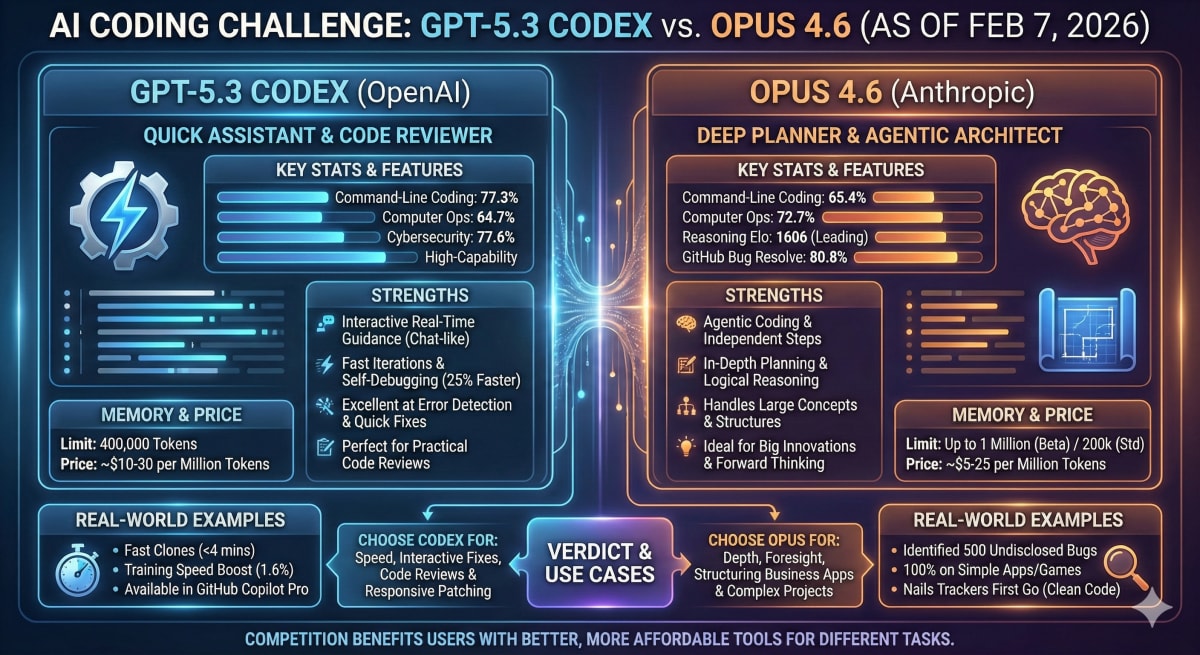
These are advanced AI models from major companies, designed to assist with coding and complex tasks. GPT-5.3 Codex is from OpenAI, the team behind ChatGPT. It acts as a quick assistant for writing code, fixing errors, and handling step-by-step computer work. Opus 4.6 comes from Anthropic, a company emphasizing safe and reliable AI. It excels at in-depth planning, logical reasoning, and managing large projects that require forward thinking. People turn to these tools because coding tasks, such as creating websites or apps, can be challenging. They serve as intelligent aids that handle much of the work, reduce time spent, and spot issues.
As of February 7, 2026, both models were released recently, generating a lot of discussion online. It feels like a competition in AI for improved coding support. User feedback varies: some prefer one for its speed, others for its intelligence. The positive side is that they are becoming more affordable and efficient. There is no clear leader; the choice depends on the task, such as rapid adjustments or detailed strategies.
According to official company details, Opus 4.6 offers extensive memory capacity—up to 1 million tokens in beta mode, or 200,000 standard—which allows it to manage large amounts of information without losing track. It achieves 65.4% on command-line coding tests, 72.7% on general computer operations, a leading 1606 Elo in reasoning challenges, and 80.8% in resolving actual GitHub bugs. Its strength lies in agentic coding, where it independently outlines steps for projects and can scale its thinking effort from basic to advanced. It costs $5 to $25 per million tokens and is readily available on their platform or cloud services. During evaluations, it identified 500 undisclosed bugs in open-source software.
For GPT-5.3 Codex, the memory limit is 400,000 tokens. It scores 77.3% on command-line coding, 64.7% on computer operations, and 77.6% on cybersecurity assessments. Its key feature is interactivity, enabling real-time guidance during tasks, similar to a conversation to refine plans. It contributed to debugging its own development and runs 25% faster than prior versions. Pricing aligns with earlier models, roughly $10 to $30 per million tokens—it is accessible via paid ChatGPT applications or integrated tools like GitHub Copilot Pro. Both companies highlight security: Opus earns top marks in certain cyber evaluations, while Codex is rated as high-capability for security with additional safeguards.
User tests show Opus perfect (100%) on simple stuff like 3D plans or games (Gemini 3 Pro matches cheap). For apps like trackers, Opus nails it first go with clean code and good looks. Codex sometimes slips with old tricks like 'cat' commands or login bugs. But Codex shines in fast clones (under 4 mins) or quick fixes, like boosting training speed 1.6%. Opus better for big innovations that stump people. Many mix them: Codex for reviews, Opus for building.
Based on public data and my own tests using Kilo Code and GitHub Copilot Pro (where Codex is available) and LM Arena (where Opus works very well but Codex isn't available), Opus 4.6 leads in reasoning, planning, and logic—ideal for agentic tasks like structuring business apps with seamless steps. It handles big concepts independently. For example, it would thoroughly outline a game with rules and spot flaws. In contrast, GPT-5.3 Codex excels at error detection, code review, and quick fixes—responsive for patching issues like faulty logins, with its fast iterations and self-debugging. When I tested using GitHub Copilot Codex with multiple questions, it reviewed code faster than alternatives. Example prompts: "Review this Python script for a web scraper—check for efficiency"; "Analyze this JavaScript function for a login system—fix any bugs"; "Evaluate this bash script for automating backups—identify errors." These show its strength in practical reviews. Overall, choose Opus for depth and foresight, Codex for speed in coding and reviews. This competition benefits users with better tools.